Anion Gap Calculator for Differential Diagnosis of Acidosis
What the anion gap Reflects
The anion gap is a derived value used in laboratory assessment of the acid-base state. It enables clinicians determine whether a patient’s metabolic acidosis is more consistent with an increased burden of unmeasured anions or with a loss of bicarbonate that is matched by a rise in chloride. In practical terms, the anion gap is a valuable screening tool for spotting patterns in electrolyte balance and directing the next step in the diagnostic approach.
Most versions of the calculation use serum sodium, serum chloride, and serum bicarbonate. The standard anion gap formula is:
Anion gap = serum sodium − (serum chloride + serum bicarbonate)
This basic formula provides a calculated value that reflects the relationship among principal measured electrolytes. Because sodium is the primary measured cation and chloride plus bicarbonate account for much of the measured anion content, the result gives a useful snapshot of acid-base analysis. When the result is beyond the expected reference range, it can point toward a defined metabolic disturbance.
The anion gap does not identify a single disease. Instead, it supports clinical interpretation by focusing the differential diagnosis. A high gap suggests the presence of unmeasured acids or toxins, while a normal gap often indicates bicarbonate loss with compensatory chloride retention. That distinction is central to acidosis workup.
Using an Anion Gap Calculator
An Anion Gap Calculator provides a simple way to apply the anion gap formula using current serum electrolytes. For correct use, input the patient’s laboratory values for Na, Cl, and bicarbonate. The calculator then returns the calculated value, which can be compared with the expected reference range and interpreted in the context of the patient’s acid-base status.
The steps are simple:
- Confirm the most recent serum sodium, serum chloride, and serum bicarbonate values.
- Input those numbers into the Anion Gap Calculator.
- Check the calculated value and compare it with the local reference range.
- Assess whether albumin is low, since that can change the corrected value.
- Evaluate the result alongside symptoms, history, and other diagnostic data.
Using this tool is not just about obtaining a number. It is about integrating that number into a broader clinical framework. A mild elevation may be significant in one patient and less important in another, depending on the underlying cause and the presence of a mixed process. Because acid-base disorders are often dynamic, repeat testing may be needed when the clinical picture changes.
It is also important to remember that a calculator is a supportive tool, not a standalone diagnosis. For example, a patient with low bicarbonate may have either high anion gap metabolic acidosis or normal anion gap metabolic acidosis. The calculator helps differentiate those possibilities and determines which branch of the differential diagnosis should be pursued first.
Interpreting a High Anion Gap
A high-gap metabolic acidosis means that unmeasured anions are building up in the bloodstream. This often suggests the presence of acids that are not directly captured by routine serum chemistry. The result is a wider gap between measured cations and measured anions, usually alongside a reduced serum bicarbonate.
Common causes include lactic acidosis, ketoacidosis, and toxic ingestion. These are among the main diagnoses to consider because they can worsen rapidly and may require urgent treatment. The anion gap is therefore a important clue in identifying an underlying cause of metabolic acidosis.
Lactic acidosis occurs when lactate accumulates, often due to hypoperfusion, sepsis, hypoxia, seizures, or certain medications and toxins. In this setting, the elevated gap reflects excess acid production or impaired clearance. Clinical context is essential, because the same laboratory pattern can occur in a wide range of critical conditions.
Ketoacidosis is another classic reason for an elevated gap. It may occur in diabetic ketoacidosis, alcoholic ketoacidosis, or starvation states. In these cases, ketone bodies function as unmeasured anions, raising the gap while bicarbonate falls. Blood glucose, ketones, and the overall clinical picture help distinguish these scenarios.
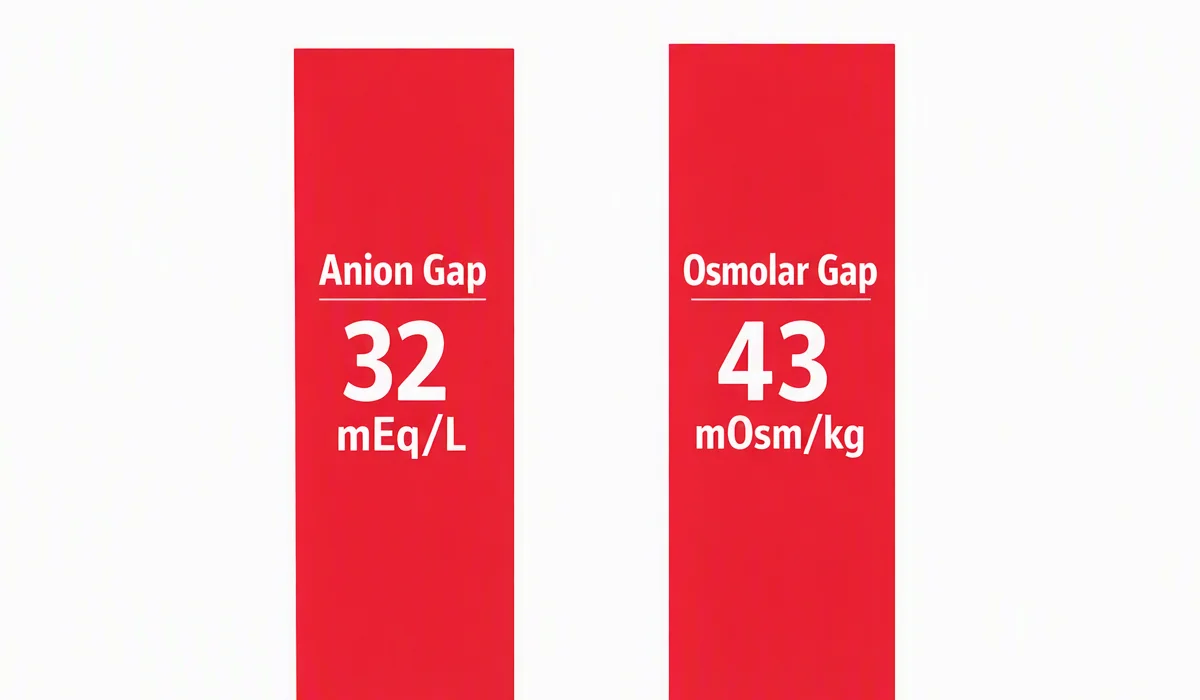
Toxic alcohol ingestion is a major diagnostic concern when the gap is elevated without an obvious explanation. Substances such as methanol, ethylene glycol, and related compounds can produce a high anion gap metabolic acidosis and may also create an elevated osmolar gap early in the course. Because timing matters, a normal osmolar gap does not completely exclude toxic exposure. If suspicion is high, urgent evaluation and targeted testing are warranted.
In practice, the elevated gap should trigger a structured diagnostic approach. Consider the patient’s symptoms, exposure history, medication list, vital signs, and organ function. An arterial blood gas can help confirm the severity of the acid-base disorder and identify whether ventilation is compensating appropriately. Together, these data sharpen the differential diagnosis and help prioritize treatment.
Interpreting a Standard Anion Gap
A normal-gap metabolic acidosis is typically caused by bicarbonate loss that is offset by a rise in chloride, which is why it is frequently referred to as chloride-associated acidosis. In this pattern, the body depletes base rather than accumulating unmeasured acid. The anion gap remains within the reference range even though the patient is acidemic.
One of the most common causes is diarrhea, which results in gastrointestinal bicarbonate loss. Because the body seeks to maintain electroneutrality, chloride rises as bicarbonate falls. This can produce a significant metabolic acidosis without an elevated anion gap.
Another notable cause is renal tubular acidosis, a group of disorders in which the kidneys cannot correctly acidify urine or conserve bicarbonate. Depending on the subtype, the patient may show persistent acidemia, low bicarbonate, and a normal anion gap. Renal function tests, urine studies, and the broader clinical context help distinguish this from gastrointestinal losses.
Other causes of normal gap acidosis may involve certain medications, early kidney disease, or iatrogenic chloride load from intravenous fluids. The key point is that a normal result does not eliminate clinically important acidosis. Instead, it shifts attention toward processes that cause bicarbonate loss or impaired renal acid handling.
Because the pattern can be hard to spot, careful acid-base analysis is helpful. If the clinical picture seems more severe than the calculated value suggests, consider whether a mixed acid-base disorder is present or whether the reference range used by the laboratory is different from the one assumed by the calculator.
Recalculating the Anion Gap for Low Albumin
Albumin is a important unmeasured anion in plasma, so reduced albumin can make the measured anion gap look lower than it really is. This is why clinicians often calculate a corrected anion gap when hypoalbuminemia is present. Without this adjustment, a clinically important high-gap process may be missed.
The concept is straightforward: if albumin is reduced, the “missing” negative charge is not part of the measured chemistry panel. As a result, the gap may look misleadingly normal. The corrected value better reflects the patient’s true acid-base status and supports clinical interpretation.
Correcting the anion gap is especially helpful in hospitalized or critically ill patients, where low albumin is common. In those settings, relying only on the raw value may downplay the severity of an acid-base disorder. The corrected value can reveal an elevated gap that supports an underlying high-gap process such as lactic acidosis, ketoacidosis, or toxic alcohol ingestion.
This adjustment is one reason the anion gap should be viewed as part of a wider set of acid-base disorders rather than as a standalone number. Albumin levels, serum chemistry, and arterial blood gas data all work together to a better interpretation guide. When the corrected anion gap differs significantly from the uncorrected result, that discrepancy itself is an useful clue.
Framework for Differential Diagnosis for Acidosis
In the assessment of metabolic acidosis, the anion gap is a useful initial step for the differential diagnosis. A systematic approach helps move from the calculated value to the most likely underlying cause.
First, verify that the patient truly has acidosis with an arterial blood gas if needed. This helps distinguish metabolic acidosis from respiratory disorders and reveals compensation. Then review the anion gap, serum bicarbonate, and chloride pattern to decide whether the acidosis is increased-gap or normal-gap.
For an elevated gap, think about accumulation of organic acids, lactate, ketones, or sodium chloride bicarbonate anion gap toxins. For a normal gap, evaluate gastrointestinal bicarbonate loss, renal tubular acidification defects, or chloride-rich fluid administration. In many cases, the next step is directed testing based on the most likely branch of the differential diagnosis.
An osmolar gap can be a valuable adjunct when toxic alcohol ingestion is possible. If the osmolar gap is elevated, it may increase suspicion for methanol, ethylene glycol, or another osmotically active substance. However, the osmolar gap and anion gap are adjunctive, not interchangeable. A patient may have one abnormality, both abnormalities, or neither depending on timing and metabolism.
Clinical interpretation should also account for the course of illness. A quickly increasing gap can suggest evolving critical illness, while a stable normal gap may point to chronic renal tubular acidosis or ongoing diarrhea. The best diagnostic approach combines the calculated value with history, exam findings, and repeated laboratory assessment when needed.
Common Missteps and Constraints
Though useful, the anion gap has restrictions. A common error is lab error, which can occur from specimen handling problems, recording errors, or equipment differences. If the result does not fit the patient’s condition, another test may be required before drawing conclusions.
The reference range can also change by laboratory method. A result that appears abnormal in one system may be borderline or even within range in another. For that reason, interpretation should be anchored to the specific lab’s interval rather than a standard cutoff.
Another constraint is the possibility of a mixed acid-base disorder. A patient may have both high anion gap metabolic acidosis and alkaline imbalance, or a elevated-gap process plus a usual-gap process at the same time. In such cases, the measured value may obscure the full extent of the metabolic disturbance.
The clinical picture matters more than any one value. For example, a patient with critical illness, altered mental status, or shock may need prompt review even if the anion gap is only modestly changed. Likewise, a patient with hypoalbuminemia may require a adjusted result before the laboratory data can be understood correctly.
When to Seek Urgent Clinical Assessment
Severe acidosis can be dangerous, especially when it occurs with critical illness. Breathing quickly, disorientation, sluggishness, chest pain, persistent vomiting, hypotension, or signs of dehydration may indicate a severe condition requiring prompt treatment. The presence of any concerning signs should prompt urgent medical evaluation.
Prompt evaluation is particularly important when a high anion gap acidosis is suspected from lactic acidosis, ketoacidosis, or toxic alcohol ingestion. These problems may worsen quickly and can lead to system dysfunction if not recognized early. A clinician may order repeat serum chemistry, an arterial blood gas, lactate, ketones, renal studies, or toxin testing depending on the presentation.
Obtain urgent care if the patient is confused, difficult to arouse, breathing rapidly, or showing signs of shock. The anion gap calculator is a helpful screening tool, but it cannot replace emergency evaluation when the patient appears unstable.
Common Questions
What does the anion gap mean and why does it matter in acidosis?
The anion gap is a derived number from routine serum chemistry that helps classify metabolic acidosis. It is important because it separates high anion gap metabolic acidosis from normal anion gap metabolic acidosis and guides the differential diagnosis by pointing toward the underlying cause.
How is the anion gap calculated from sodium, chloride, and bicarbonate?
The most common anion gap calculation is serum sodium minus the sum of serum chloride and serum bicarbonate. In formula form, it is: anion gap = sodium − (chloride + bicarbonate). An Anion Gap Calculator performs this calculation automatically from the laboratory values.
Why does high anion gap metabolic acidosis happen?
Typical causes are lactic acidosis, ketoacidosis, and toxic alcohol ingestion. Other causes may include kidney failure, certain medications, and toxin exposure. The elevated gap reflects unmeasured acids accumulating in the blood.
What can cause a normal anion gap metabolic acidosis?
Normal anion gap metabolic acidosis is commonly due to diarrhea, tubular acidification defects, and high-chloride IV fluids. It is also called a hyperchloremic state because chloride goes up as bicarbonate decreases, keeping the gap within the reference range.
Why should the anion gap corrected for albumin?
Serum albumin is a major unmeasured anion, so hypoalbuminemia can make the anion gap look artificially low. Correcting for hypoalbuminemia provides a corrected anion gap that more closely matches the true acid-base disorder and can unmask a hidden high-gap process.